

Temples of Nepal
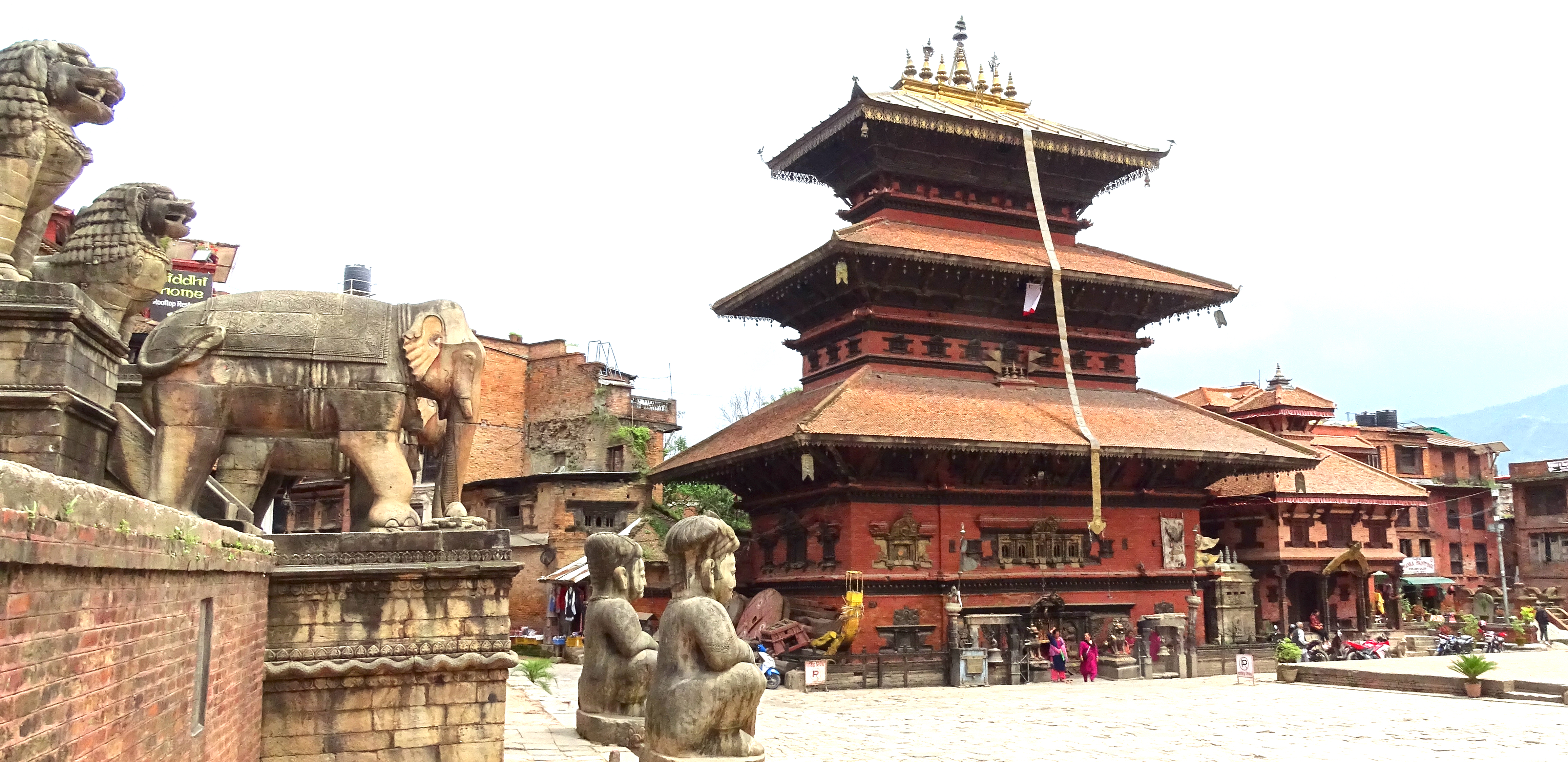
The Hindu temples at Pashupatinath, Bhaktapur and various other places have the simple, distinctive pagoda design seen across Nepal. The stacked, sloping rooves are not coated with gold. The main structures are made of stone and timber, weathered and darkened by millenia, eroded by earthquakes, humidity, torrential rain and hail. They go back thousands of years and contain hidden treasures celebrated in legend by Hindus worldwide. Their antiquity is the key to their value, although they need rebuilding every few hundred years as nature takes its toll. They are not only monuments from the past, they are continually being renewed, and have been for thousands of years.
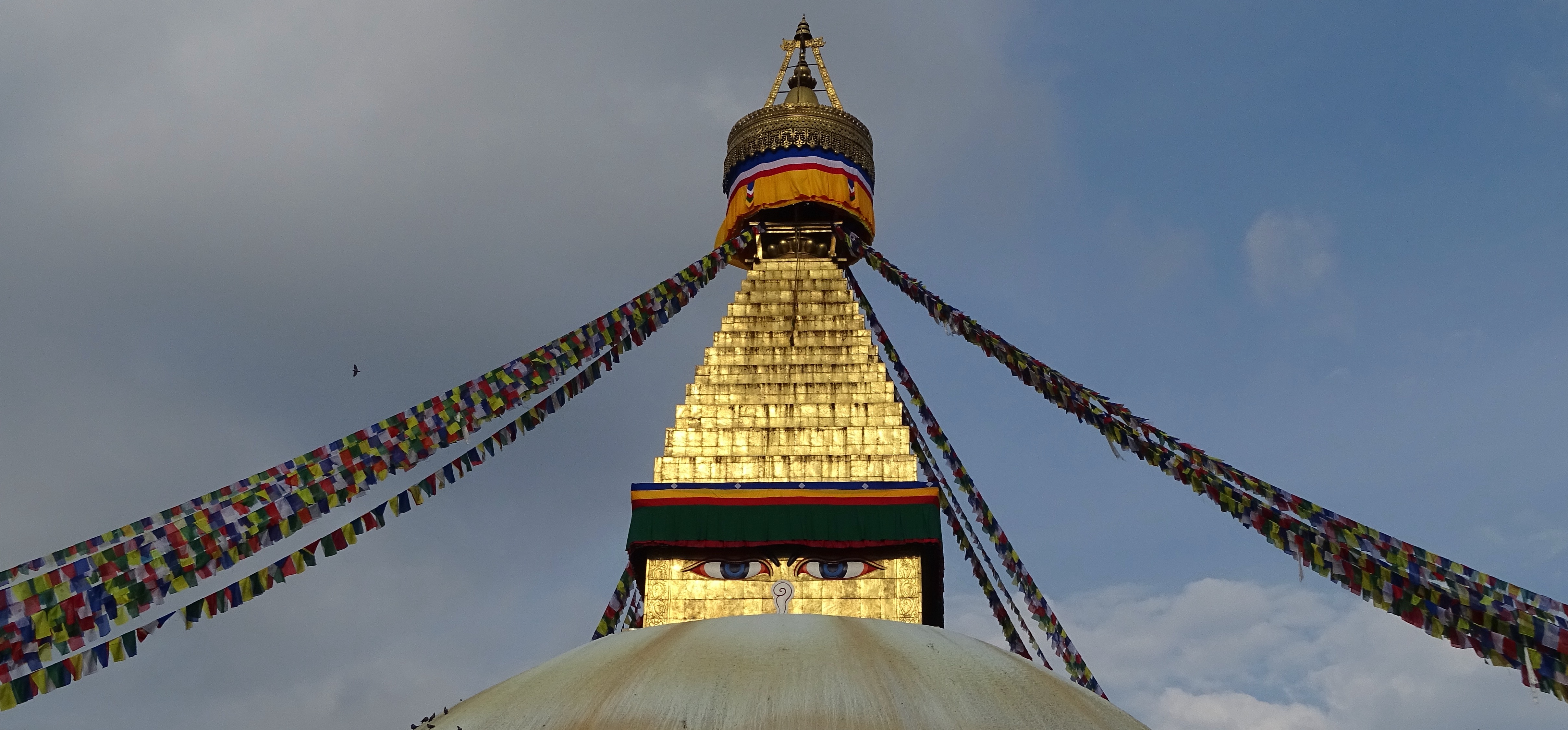
I took a drive one day to see the beautiful Buddhist stupa, Boudhanath, in Kathmandu, with its eerie ‘Buddha eyes’ and harmonious form. It is a reminder of the closeness and consistent presence of Siddartha Gautama in Nepali Hinduism. Many Newaris are Buddhist and ancient Hindu epics are common to both religions.
Siva mandiras are more numerous. I asked an Indian friend long ago if Siva was the most powerful of all the Hindu gods. He replied “Yes! Except for Parvati, because she is his wife. And Kali.” It’s not actually possible to get a western-style appraisal of Indo-Nepali spirituality, but Siva seems to be the most revered of the Hindu deities. Everytime I try to read up on these things I get lost in the different worlds contained in classical Hinduism, but for me Siva is the only Hindu deity, except for Parvati who collaborated with him on the book “Vigyan Bhairava Tantra” which translates as ‘Methods for Going Beyond’.
“Vigyan Bhairava Tantra”, expounded at length in Osho’s “Book of the Secrets”, is the original text which describes meditation and it goes much further by giving one hundred and twelve techniques with the aim of providing a suitable one for every person, and every type of person, in existence. It was composed before it could be written and must have been one of the first books to be recorded when script and tablets were later invented.
Siva walked in the mountains five thousand years ago. Two and a half thousand years later Buddha appeared in the same region, a few hundred miles south on the plains at Lumbini, and simplified the idea of meditation to one technique; vipassana, or watching the breath, which is also derived from Siva’s methods. It’s a reasonable assumption that, as everyone has to breath, this one technique should be suitable for everyone. No need to try, or memorise, a hundred and twelve possibilities. Two and a half thousand years after Buddha, Osho came along, a little further south in Madhya Pradesh, and popularised several meditations, again employing elements of Siva’s ideas, combined with music and the use of modern technology.
It seems that the original manual does indeed contain all that is needed to experience and enjoy meditation. Meditation is important because it is the only reliable spiritual technique available. Other religions don’t have such practices, relying on logic and words to communicate essential truth which is beyond words, thoughts and beliefs. This can work but it can also be arduous without any clear path to fall back on. A few years of intense meditation is enough to gain a deep understanding of the experience. You don’t have to do it forever, its effects stay with you.
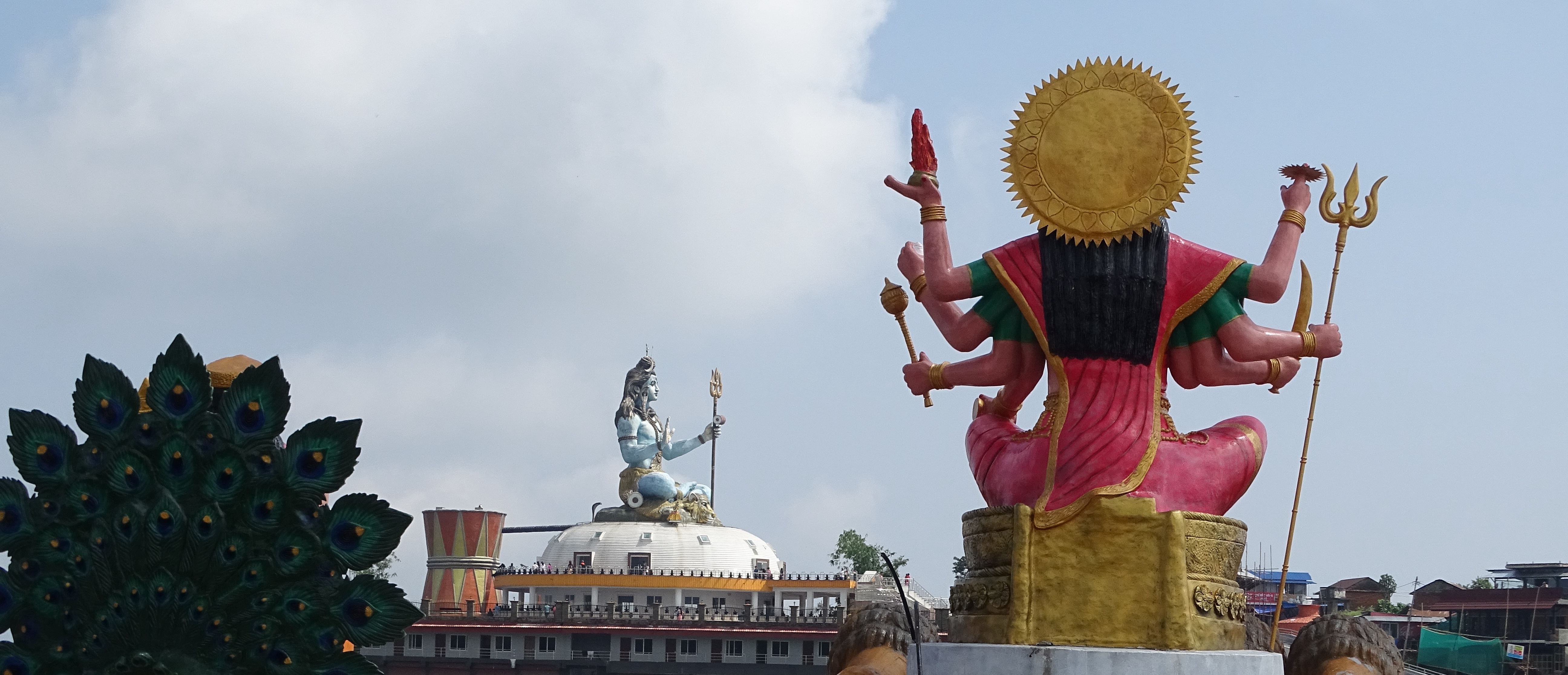
More recent Nepali structures freely combine pagoda and stupa styles, ancient figures and modern materials, in a modern montage. Although Nepal was ancient its people are not. They tend to be very contemporary in their outlook, more so than the other Asian nations I know, although the opposite is true of their technological abilities, where they lag behind. The mountains and traditions have held them back, and helped preserve their unique culture.
One day I hired a cab to take me to the most ancient and significant Siva mandira in Pokhara. That’s what I instructed the driver and we agreed on a hefty sum (in local terms) for the return journey. He brought me to a small, unimpressive dark little building in the middle of a narrow, busy road. I thought there must have been a misunderstanding but there wasn’t. In Nepal it is the antiquity and authenticity which are prized, not size or opulence.
I couldn’t see anything there to photograph. I asked him to take me somewhere more photogenic and we went to a much grander place not far away which gave me plenty to work with in the half hour or so before a monsoonal shower ended the adventure.
The reason many Nepali mandira are in the middle of roads is that the roads came later, and they connected the temples. When, over time, an increase in traffic demanded more space the road sometimes divided around the mandir which was eventually stranded in the middle. More often the road is just at the side. They were not planned, they had just evolved that way.
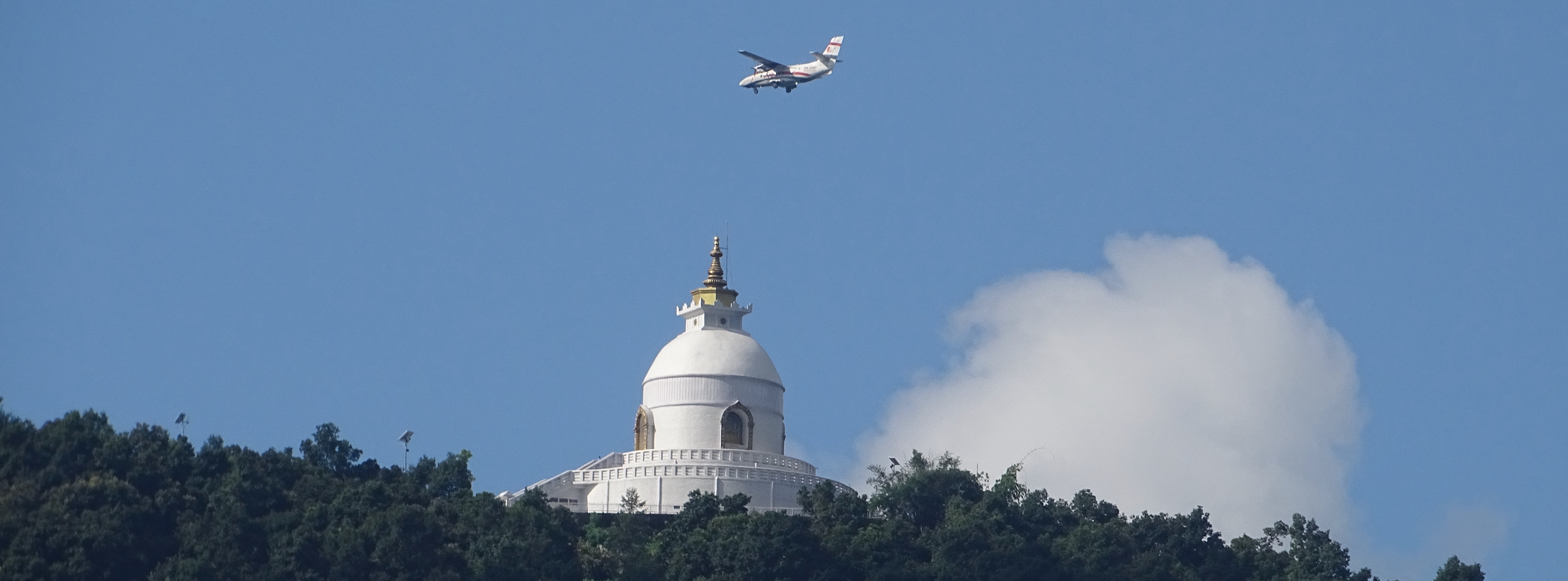
Pokhara Shanti Stupa, built in the nineteen seventies as a symbol of peace by Nichidatsu Fujii, a famous Buddhist monk from Japan, overlooks Lake Phewa from Anadu Hill at a height of eleven hundred metres. Elegant and serene, it graces the skyline although there still isn’t any world peace, there is a war industry instead to which humanity devotes all its spare wealth. The word shanti, from Sanskrit, means peace, and the Buddhists are, at the moment, the only ones talking about it in a world of conflict and misunderstanding.
Nearby, the huge ‘Pumdikot’ Siva Statue, one of the biggest in Nepal, has been recently erected on a slightly higher level. There is no rivalry, however, unless it is a friendly one. They are both busy with tourists and from each, and the trail in between, you can see, on a clear day, the dramatic sight of the Annapurna ranges, only about twenty kilometres away to the north behind the lake and the metropolis.

In a Buddhist settlement on the north side of town I was shown a pile of rocks and told this was an important monument. People have contributed to the pile for a long time and at the botom there are rumoured to be precious artefacts, but we will never see them. Some of the stones had inscriptions and carvings on them. It was another reminder that significance is interpreted differently in the mountains. With the omnipresent, spectacular beauty of nature all around the temples are not meant to look impressive, but to mean something, in the present and historically.
As Nepal attempts to modernise there is a constant tension between the conservation of culture and the adoption of inferior but cheaper methods from China and the West. The temples and mandira become all the more valuable as the world around them strays from the spiritual towards the materialistic demands of modernity. The many festivals celebrated in Nepal show the old traditions are still alive and healthy despite the multifarious pressures to join the modern world of efficiency, conformity and central control.
 Travels to Nepal