

Quan Seven
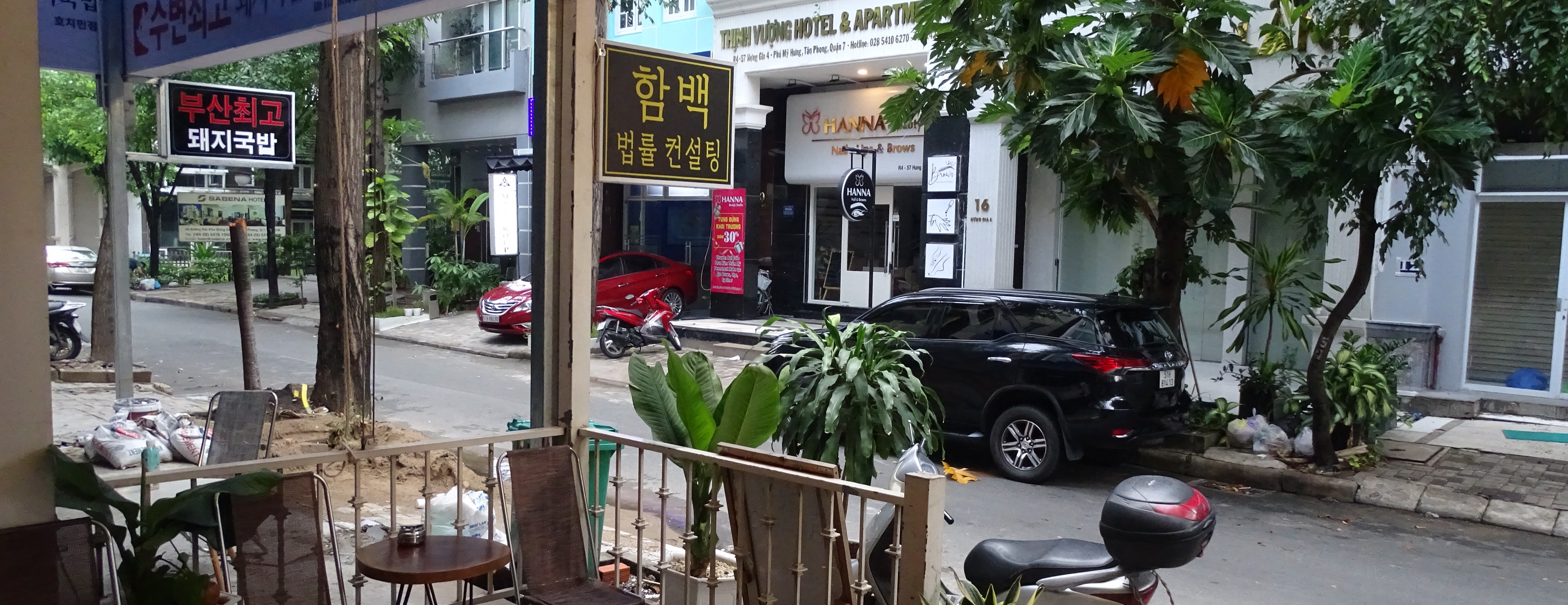
I had booked an apartment with a balcony, air conditioning, wi fi, a simple kitchen, a bathroom with hot water and access to shops and restauants. There was a small supermarket across the road. There many restaurants including a Vietnamese vegetarian one and an Indian place run by two emigres on the edge of a small park. I told them I was going to Mumbai soon but they weren’t that impressed. They kept their opinions to themselves but were as friendly and obliging as the locals.
I soon found that the Vietnamese love coffee. Cafes were numerous and just about every restaurant had a cappuccino machine. Quan Seven is known as ‘Little Korea’ and is dotted with barbecue restaurants. The Koreans must like coffee too. My host, Hong, had a little coffee shop operating on her balcony producing a local brew that was incredibly strong. I couldn’t drink it black as she did and even drowned in milk it was still powerful. Locals popped in from time to time and she occasionally went off to deliver to nearby shops.
There was a great variety of small shops; pharmacies, electrical shops, small supermarkets and all kinds of specialty stores crowded together on the main roads, spilling into alleys and by-ways. There were leafy little parks on every other block and hotels galore.
Hong was slim and attractive and looked about thirty though she had two teenage sons. She claimed to have a husband somewhere but I never saw him. She was there to greet me when I arrived, as I was expressing my disappointment with taxi drivers and the general lack of respect for the aged, which I had only discovered myself a few years before when I became old. She had responded in a warm, motherly way, patting me on the arm and consoling me with kind humour. Her smile improved my mood and I appreciated her caring response, even though I knew she was only joking.

Ho Chi Minh City was a surprise: modern and lively with a unique character which reminded me of South America. South East Asian/Latino. I even heard a Brazilian influence in some of the Vietnamese guitarists I saw online. There were hang-out spaces outside stores, in parks and wherever a few people could get together. Old men sat on stools and played games while chatting and laughing loudly. Young people were catching up and drinking coffee together in the balmy evenings.
It was hot and humid. The monsoon was brewing, building up to that point where it couldn’t hold back anymore and would erupt upon the earth. Occasional storms warned of the coming tempest but everyone went on their way, wiping sweat off their brows and calmly enduring the incessant heat.
I panicked at one point when I realised I risked losing control of my bank account and other aspects of my legal identity because I had cancelled my phone contract in Australia the day I left. This created unexpected complications as I had been using the phone and the old number as a second proof of identity and in some cases I was unable to log in to accounts until I figured out a way of phoning Australia and the US from Asia with a local phone number. It wasn’t clear which numbers I should be calling and those numbers changed according to the situation and location.
The problem was confused by a few social media sites I had joined under false names with different birth dates. It was once considered, and perhaps still is, wise not to publish one’s personal data online, but now, travelling over the seas, there could be a problem if I ever had to prove who I was. I had to straighten out my accounts and use my actual name and details, and not rely on a phone number.

Hong had a suggestion; a phone app with which you could make international calls for free. After getting onto my bank by phone a couple of times I found that it wasn’t only the phone that was a problem. There had been some disagreement at a governmental level over the kind of secure messaging the bank required for verifications and several Asian countries including Hong Kong and Vietnam didn’t allow that. paricular protocol. More importantly, though, the ATMs accepted my card. I made the necessary account changes over the phone, verified my existence and location and that was sorted.
Access to my Australian bank accounts was obviously essential. It was theoretically guaranteed and all my arrangements were compatible with the policies of the relevant departments and the government was fully aware of my movements as the modern surveillance state demands, but there were things which could go wrong and many of the systems I was relying on were new and somewhat fluid.
I made trips to the Post Office and Customs in search of my guitars. They had been diverted somehow. There was an arrangement that the bags and luggage of short-term tourists were not examined, but that didn’t apply to the post. Many South East Asian countries restrict the movement of ‘second-hand electrical goods’ for some reason, and there was a concern that my instruments fitted this category. One of the guitars was an archtop electric which I had bought new. Was it now considered second-hand? Only if I sold it, I thought. I couldn’t figure it out.
The Post Office was in a beautiful old French building with a high curved ceiling. There were three types of architecture around Ho Chi Minh City; the old Vietnamese, the later French and the modern sky-scrapers. The latter were simple and severe, concrete and glass, like in any other wealthy modern city centre. The local styles were influenced by China and included small temples hidden between houses and some larger ones which were tourist attractions.
Customs House was a combination of the French and modern styles. I got some pictures while I was waiting. There was also an expensive Indian restaurant around the corner. I got drenched going there one morning. I was only twenty metres away when a sudden torrential downpour caught me out. The staff got me a towel and made me comfortable and gave me an excellent meal of rice, dahl and palak paneer. I left a little on the plate, as is the Indian custom, to show that I was fully satiated.
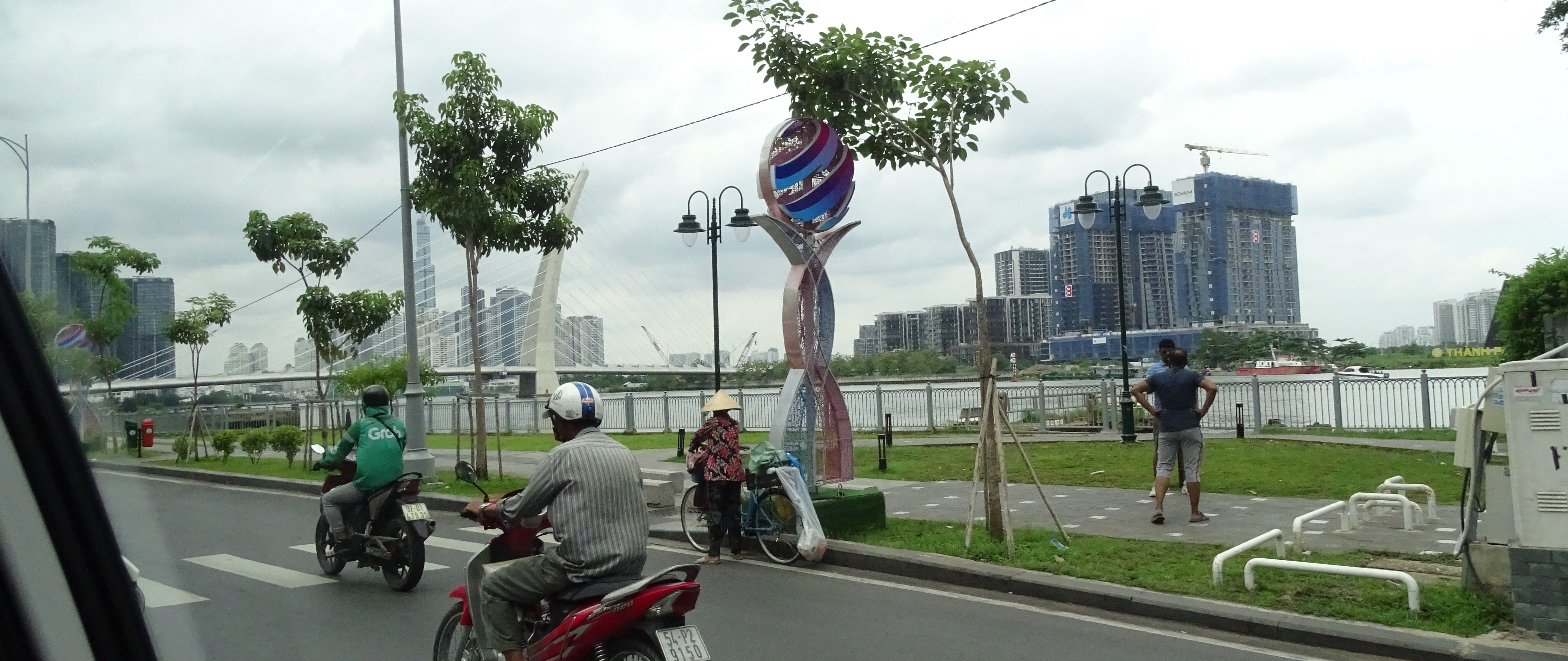
The Saigon River was a pleasant stroll, without cafes. It looked clean and well-organised with fences and footpaths. I walked over and took a few photos. The traffic was fierce, especially to someone accustomed to country towns in Australia.
Driving around in taxis, visiting temples and government offices, I got a good look at the place. It was great to know that almost everybody I came across was friendly, helpful and well-intentioned. The women laughed at me but not in an unkind way. I got used to being laughed at and never minded because I knew there was genuine sympathy and compassion behind the laughter. Like the way Hong laughed at my new hair-cut which seemed to be styled on that of the infamous North Korean leader and looked ridiculous on me, and then bit her tongue when she thought I might be embarrassed. She had, after all, recommended the hair dresser. I didn’t care. I liked it when she laughed. There was a lot of respect for traditional spiritual and human values in the local people. It was comforting.
I still hadn’t got hold of my guitars but I knew where they were and I felt confident I would have them soon. The woman in charge of the customs depot where they were being held was near my age with a fine-featured face with wrinkles under sad eyes that spoke of regret and compassion acquired with dignity and difficulty. Responsibility and awareness of the consequences of her power and government policies on the lives of ordinary people had taken their toll, or so I imagined. Or maybe it was a personal tragedy. Something had happened. Something happens to all of us if we live long enough. I would have loved to have known more.
 Travels to Nepal