

Phewa Lake
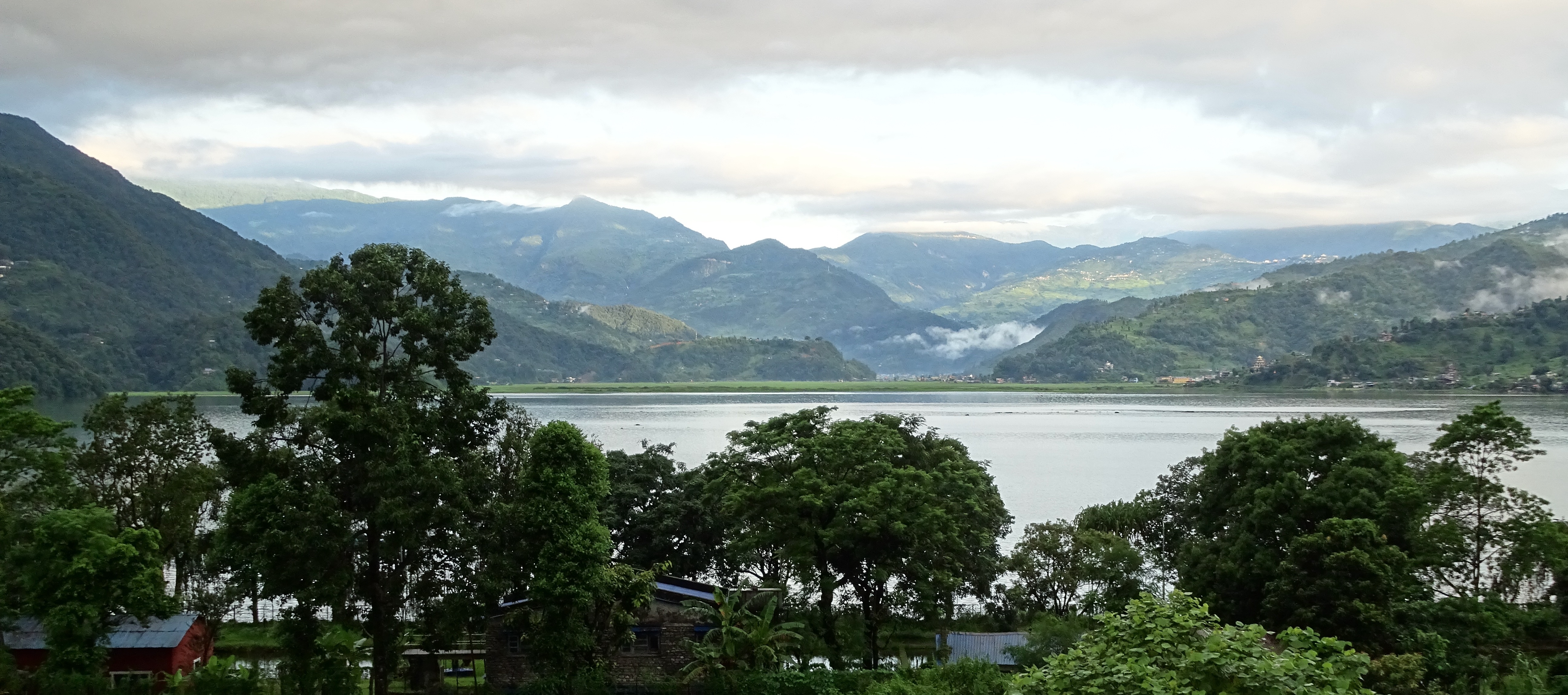
The heart of Pokhara is the magnificent Phewa Lake. Picturesque and vast, it is busy, on its western shore, with restaurants, street merchants, photographers, tourists, seafarers and locals. People build boats on the banks and catch fish in the shallows, spruikers invite bypassers into the cafes, music plays from various sources and the atmosphere is lively and joyous.
The lake has a life of its own and it was a pleasant, reassuring companion every time I wandered down to my friends’ cafe with the excellent cappucino and comfortable lounges and interesting music, usually dub, blues or something Nepali.
It reminded me of James Joyce’s descriptions of his walks around his neighbourhood in Dublin where he passed bakeries, pubs, shops, and cafes with the aromas of coffee, tobacco and freshly baked bread floating out onto the street and encountered different characters on the way. His narrations had always fascinated me. Years later I found some neighbourhoods like the ones he described and now in Pokhara I had found the lake. I enjoyed just being there, walking around alone, breathing the fresh air and seeing the happy people taking selfies, making little videos for the internet, meeting friends and enjoying the peaceful beauty of the place.

There were several lanes leading down from the main street to the lake, with cloth and jewellery stores and kitchens with wood fires along the edge of the street where they cooked chicken, fish and god know’s what on their simple burners and the air was full of smoke and aromas that made even a vegetarian hungry. A small Siva temple was situated on the corner of the lane and the promenade and there were cumbersome turnstiles, designed to prevent scooters and bicycles from accessing the shore, through which one had to squeeze to reach the water’s edge.
Shankaraji had established his restaurant many years before when Western tourists were plentiful and business went well for a while with other places springing up around him selling juices and food until one night one of them caught fire and the blaze spread to Shankaraji’s building, the original and biggest of them all, and erased in an evening the work of a decade. An expensive sound system, quality furniture, the well equipped kitchen; everything was gone. Then, when they struggled to rebuild, further tragedies occurred, like the covid lockdowns and a plane crash at the newly built airport.
The first time I visited the cafe I was there quite a while before torrential rain began just as I was preparing to leave so I asked if I could borrow an umbrella. They didn’t have any small ones but there were beach umbrellas over the tables and they lent me one of them. I received a lot of smiling compliments on the way home for my unusual brolly but it got me to a taxi without getting drenched. Later that night I set out with it from my apartment for the shops nearby when my host, on seeing me leaving, insisted on lending me a smaller one. The big one, he told me, ‘looked peculiar’. I was impressed with his English and also my own ability to transgress behavioural norms even here, in Pokhara, Nepal. For some people there is simply no point in trying to appear normal. I had long known that I was one of them.

People here had known a great deal of adversity but you wouldn’t notice. Their cheerfulness and friendliness survived everything. They had lost money from every disaster that befell the place. Earthquakes, crashes, buses falling into rivers and landslides, but despite their struggles they could still manage a smile and a shrug of the shoulders.
Although they felt like their businesses were failing I could see that success would destroy their paradise by the water’s edge, that they would make money one day but lose their happiness in the pursuit of pleasure and wealth. I had seen it happen in many places but still they had to work and build up their businesses, surviving day to day in the hope of a prosperous future. What else could they do?
When locals asked me where I was living and how much rent I was paying they always shook their heads in mock disbelief. The rents, while very reasonable by Australian standards, were wildly inflated according to them. Twenty years ago they hardly saw money. It was rare and valuable but now prices were spiralling as a few got wealthy and well-heeled tourists began arriving. Shankaraji kept telling me there was much better value around so I asked him to find me a place.
We drove around with me on the back of his scooter enquiring at several places before I ended up in a modest apartment with a tiny balcony that frightened me. I could only use it to hang out my washing. It overlooked a patch of corn next door. There was a lot of backyard agriculture going on between the concrete apartment buildings. There was food drying on sunlit surfaces and cattle wandering the streets.

There was a quirky little Siva temple in sight on the verge of the forested hillside nearby. It was built over a natural spring which overflowed and ran down the lane by my building, constantly gurgling during the wet season where it disappeared into a drain under the road. And there were schoolkids playing football every afternoon when the day had cooled down. They were always shouting and yelling and having a great time but it was an unsuitable place for my musical needs. I had a mobile recording studio with me and needed a quiet, conducive space to set it up.
I was geting on very well with the older couple who ran a small store across the road but that changed when I got sick. I had a bad cough for a week and they noticed. There were various bugs going round and parents were naturally anxious about their children with the nightmare legacy of the covid scare still fresh in their minds and a distrust of foreigners as a result and they had obviously decided that I was a danger at that particular time. I couldn’t blame them, of course, but it limited my social options and the apartment was looking like a bad deal.
I decided to go the other way and look for something really nice with a view of the lake. A hundred and fifty Australian dollars a week was less than a third of my pension and I was more than happy to pay that for a nice place. I found one online and was able to go down and have a look at it before I committed to it. It was on the third floor with a huge private balcony overlooking the lake. The view was magnificent. I told people it was a million dollar view because that’s what it would have cost in the West.
It was over a large massage business with young masseuses who were as noisy as teenagers on a holiday away from home without any senior relatives requiring deference to dampen their enthusiasm. They had a party most nights after knocking off at eleven and ran out of steam an hour or so. I liked their chatter, though, and their youthful energy. One night they were having such a great time, laughing so much they were almost in hysterics and I couldn’t help laughing along with them, quietly, in my bed, as I was drifting off to sleep.
This was fine as it allowed me to play acoustic guitar as loud as I wanted, at at any time of day or night. They wouldn’t notice much, though they did pay me the occasional compliment. It wasn’t great for recording but I wasn’t ready to record anyway as I was still adjusting to my arthritic fingers which had deteriorated suddenly in the last five years. I was trying to adjust my style so that I could play without pain because I knew that pain would destroy my joy and that would destroy my inspiration. It would also mean that the deterioration was continuing unabated. I hadn’t found a solution but I was trying, simplifying arrangements, tuning a semi-tone down and playing as lightly as possible.

It was at Shankaraji’s cafe that I met a shaman from Joomla, a remote area in the north-western mountains, who was peddling some natural medicines in town and around the lake. All his clothes were hand-tailored in traditional styles, with coarse weaves and natural colours. He wore baggy pants and a long sleeved kurta top with a waistcoat and a Dacca topi, a peaked cloth cap, over his short grey hair. He carried a couple of plastic boxes containing various medicinal treasures from his mountain home which he sold on the streets of Pokhara and around the lake.
He recommended I use shilajit specifically for the arthritis. I couldn’t be sure we understood each other at first, having little language in common, but we used signs and friends helped with translation and they assured me I had understood correctly. I purchased a stick of the gooey black stuff but I refused to try some of his other products which were a little too exotic for me. One was a dried caterpillar which suffered from a fatal parasite that grew out of its head. It was to be consumed whole and I wasn’t doing that. Those kind of things and the use of cow excrement, for example, were beyond me, though I have been assured many times that they do actually work.
The shilajit, however, was promising. I noticed after a few days that I had played three complete songs without pain or even the consciousness of pain. I had forgotten about it for fifteen minutes. I would continue with this method which was known in all mountainous regions of the earth and was my first hope that there was a treatment for me.
Shilajit is basically a mush of organic matter which has existed within the mountains for millions of years and is slowly being squeezed out as a black paste containing a vast array of rare elements that play a role in the human body and need occasional replenishment. I had learnt over time that the human body was like a vast continent containing countless elements that were still a mystery to physicians and that there were many medicines and treatments unknown to the West. These were often suppressed as they challenged the accepted medical order and could not be certified or easily monetised.
I had come to think of the onset of old age as a transitionary period when the body changes from one state to another. It would be crucial how I adapted and that would decide how long I could survive in this new fragile and vulnerable state of being. I had heard of many men, and known a few, who had quit work at first and then returned to it when they realised thay needed to stay active and keep ‘out of the house’ as much as possible. It was one approach for people who were used to regular nine to five working hours and still had the desire to do that. For me it would be something different, but I planned to find a way.
 Travels to Nepal