

Life in Kathmandu

The shops were, as in Vietnam, disorganised, decentralised and all over the place. There were myriad tiny stores with different selections of goods. I found a tiny local tea shop which carried cigarettes and milk. Then again, milk was not always available, they would sell out everyday at some time in the evening and I would have to go inquiring at other small places until I found someone with half a litre to spare. Cigarettes were also uncertain, in fact everything depended on the weather, the time of day and the moods of the shop-keepers.
One morning in that particular store I was asking for milk in my broken Hindi when the proprietor, a thick set, powerfully built man who looked dangerously short-tempered interrupted me in perfect English to ask “Do you want milk? How much, half a litre?” He frightened me. He seemed capable of anything. I was careful not to look too long or smile too much. I tried to make myself invisible. He seemed to be suspicious of me.
I would buy milk and cigarettes there to take back to my apartment where I would make coffee and smoke charas on the balcony, aware of people perched in various locations around me, on balconies and rooves, who could see me but kept their attention to themselves. They were used to crowded conditions and knew how to keep out of each other’s way.
I had hoped to visit the Osho Ashram in Kathmandu as I had gained a good impression of it from various sources. I thought it could be a good place to set up my studio and as they were advertising on their web site for workers there might be a way for me to join the community. The main man seemed to be a facilitator rather than a strong personality. His ashram was organised along the lines of Osho’s Pune One ashram and sounded like a fruitful place for an old disciple like myself, but when I contacted them they were not interested. They suggested I do some of the regular meditations. They denied that they needed any workers. I don’t know if their website was out of date (in which case they needed a web designer) or if they were just wary of old sannyasins with their disruptive memories of the glorious past.

When I tried to organise a visit it was not so easy. The road was rough and required a four-wheel drive and although it wasn’t far away it took quite a while to get there. Reluctantly I gave up on the idea of finding a haven there. Anyway they didn’t use live music. They relied exclusively on bland digital recordings. In the meantime I had become friendly with my hosts’ regular driver, who advised me to go to Pokhara, which he assured me was the right place for me.
I vaguely remembered talk about Pokhara from many years ago. It was the quieter part of Nepal, a smaller town away from the teeming metropolis, frequented by musicians and artisans, experienced travelers and mountaineers who regarded a it as the hidden gem of Nepal. I found information online which seemed to confirm these opinions and suggested the presence of jazz and blues venues and ‘world-class’ cuisine. I was to find out that this was accurate, in a distinctly Nepali way. It was like that, but different, and I was, in the end, very glad I went there. I started to make preparations.
There is a beautiful dream I had once – I don’t remember when – set in my teenage years when I had left my parents’ home and lived with hippies and other homeless souls in squats around inner-city Sydney. There were some gorgeous places available; an old boat shed at Lavender Bay, a mansion with tennis courts at Centennial Park and old sandstone, semi-detached terrace houses in Glebe. They were neglected but perfectly functional. The walls and doors were solid. There were fireplaces, cornices and niches, touches of the architecture of my grandparents’ times. Pressed metal ceilings looked down on hardwood floors and the gardens were lush and overgrown.
The house in the dream was down in Glebe Point, just a little way from the harbour. There were mint shrubs around the outdoor tap and vines growing over the windows and up the weather-beaten walls. It was the kind of house you see nowadays in idyllic rural fantasies, but this was the inner city of Sydney, fifty years ago. I entered it, in the dream, with a joyous sense of wonder.
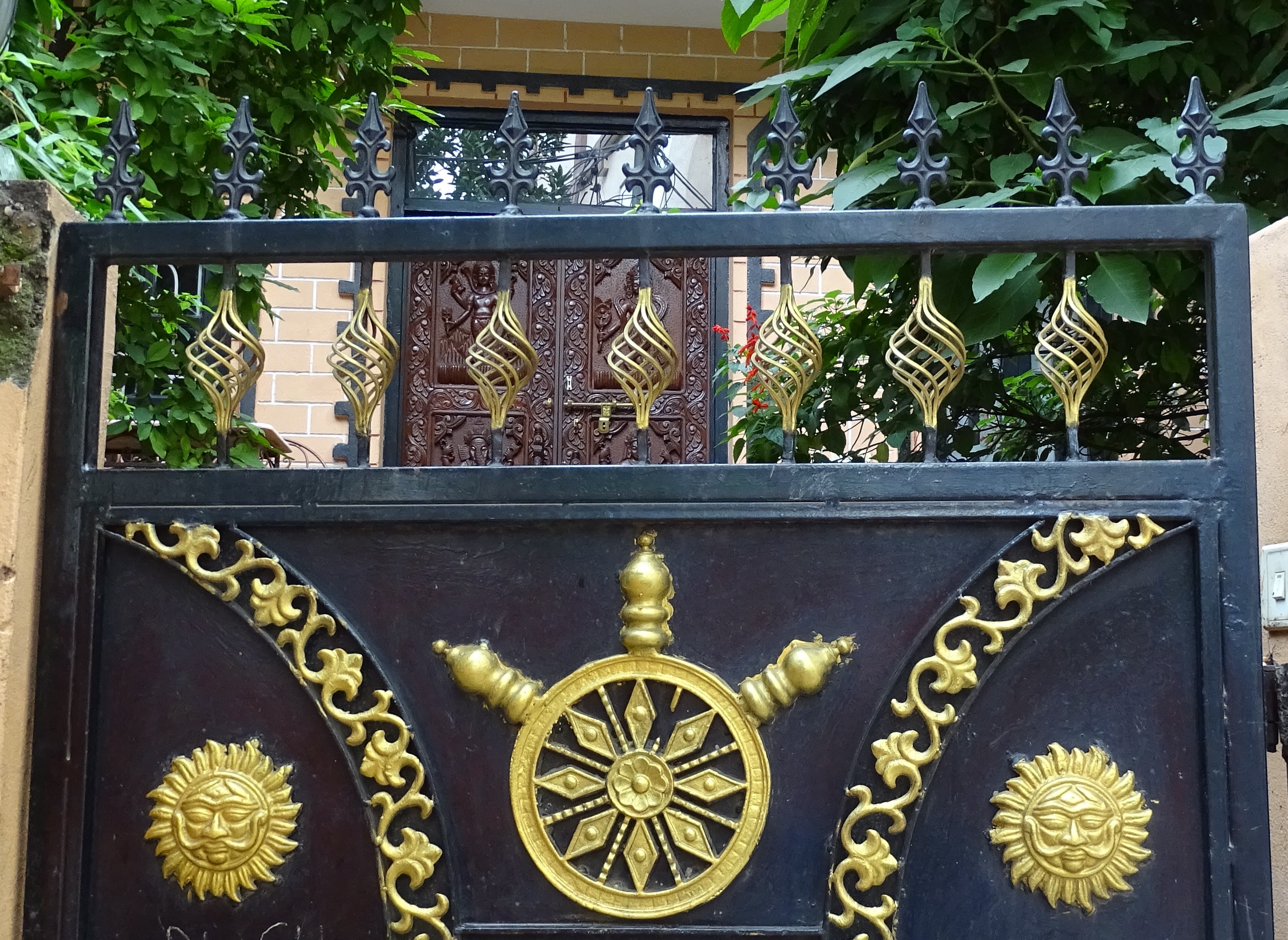
In Kathmandu I remembered that dream and those stress-free times as I relaxed in the spacious apartment and it was almost as if I was back there, picking up a thread I thought I had lost. It was a delicious deja vu and I felt a deep calm, as if I had finally arrived somewhere.
It turned out the friendly driver had a cousin who was an accomplished musician. He sent me some links and I watched some videos. Dipu was a virtuoso on several instruments, some of them electronic. He was quite young and obviously a prodigy. His timing was immaculate and energetic. Melodically he was true to the Nepali sound which, to my ears, is like a branch of Indian music but with a different flavour and a uniqueness which takes a while to recognise. He organised a meeting and came and picked me up on his Royal Enfield motor bike.
I juggled my archtop on the back with its huge case as we zig-zagged for half an hour through the dense Kathmandu traffic over uneven, muddy roads until we came to a leafier, quietly prosperous area and entered a small building which housed a recording studio and the man who ran it.
Kriti had a perfect command of English and a thorough knowledge of music. He told me, after we had played a few tunes, that Nepal was not ready for complex chords such as 13ths, flat 11s and so on: the ones known as “jazz chords”. I didn’t want to believe him, I don’t know why. I have an inner stubbornness which emerges when faced with unpleasant or incomprehensible ideas.
Incomprehensible to me, that is, because of the stubbornness, I suppose. I didn’t want to believe him but I was to find out that he was perceptive and accurate. I wondered where he had been educated because he certainly knew his stuff.
He told me he and his partner were Newars. It was the first time I had heard the name. There were many languages and cultures combined in modern Nepal, a subject I was to follow up later as I ventured deeper into the remote Himalayan culture. I was to discover that Nepal is not an ancient country. It was founded in 1768 in something close to its present form by a Gurkha; King Prithvi Narayan Shah. It then lost a war, and some of its territory, to the British marauders in the early nineteenth century. It did not become a colony. Mountainous places are a lot harder to conquer. When India gained independence from Britain agreements were made and the shared border with India has remained open ever since.
The Newars are indigenous to Kathmandu and used to control the area before it became united as Nepal. The words Nepal and Newar are related. The Nepal Mandala was an older version of Nepal, based around the many temples and Mandira of the Kathmandu Valley. It did not include Gurkha or most of the rest of modern Nepal.
Kriti’s studio was well equipped and busy with work from television and the music world. Other musos dropped by and I regretted that I had given notice at my apartment and was leaving for Pokhara the next day. I planned to do some work with them after I established my studio, whenever that would be, but there were many more turnings to take yet and life was preparing more adventures in the very near future.
 Travels to Nepal