

After the Monsoon

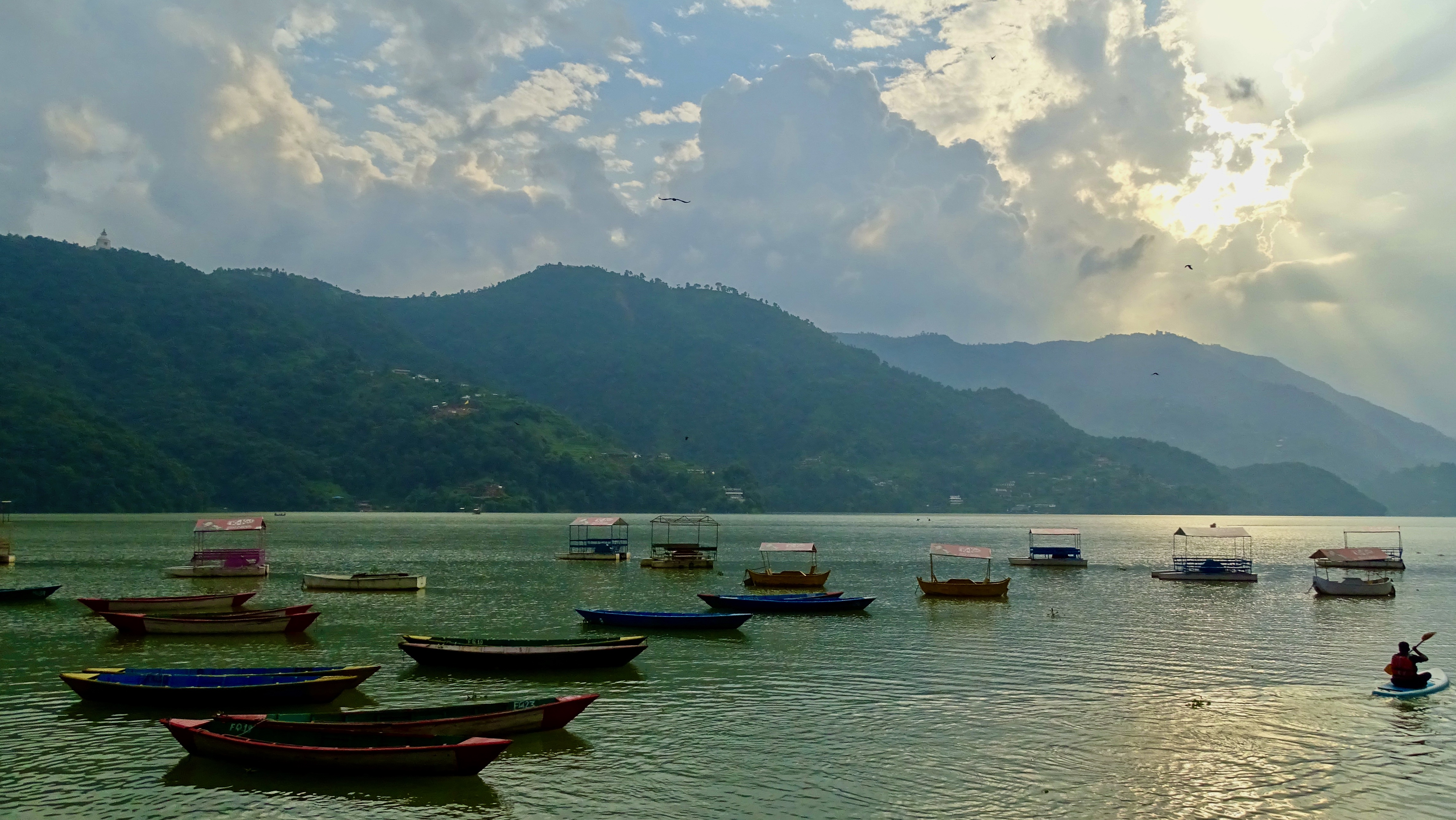
The monsoon was well over by now and the temperatures were ideal. Every day I walked down to the lake. I was now five minutes from my favourite cappucino and I got to know a few of the regulars who hung out in that part of the ‘foot track’. Dealers on the corner would offer me hash, in the form of ‘temple balls’, whatever that meant, and I always promised to buy something from them tomorrow, or next week. It never happened, but they were nice people. There were also the boat people who were trying to sell seats on their on their short cruises and I did eventually take one of them. I hired a large boat for myself just to take photos and experience the lake from another angle.
It was a good ride but I couldn’t relax with the captain who pedalled uneasily, for some reason, the whole way. Either he didn’t trust me or something else was going on but otherwise the trip was a smooth one and he gave me some interesting information. We passed a couple of boatloads of military cadets singing traditional songs as they rowed vigourously, scooting across the smooth surface, disturbing it with their wake. There was a holy island with a Siva temple to explore. We docked quietly, the old boat clanking gently onto a concrete ramp, and I wandered around the old brick and stone structures or a while. There wasn’t a lot there, but I was told it was a significant mandir, known to all Hindus.
After the dealers and the boatmen was a middle-aged woman with a cute toothy smile selling coffee, tea and trinkets. She was always happy when she saw me coming and offered me a drink and cleared a spot for me to sit with her underneath her shady tree. She told me about some of the ethnic costumes people were wearing and about the jewellery market and the attitudes of the tourists. I bought a few baubles, without bargaining, and always tipped her for the drinks which made her happy. Her first name meant ‘imagination’ and her surname was the caste name of the goldsmiths. One of her brothers still worked with gold but the rest of the family had diversified and caste discrimination was now illegal, though of course it persisted, as it does in every country I had ever been.
Her parents began their family in a small remote village, typical of the old Nepal. There was no money there, it was all subsistence farming as their ancestors had practiced, but there were plenty of wild animals and there was no point owning a dog; they were prey for the big cats roaming the jungle. Her father was a builder who made the traditional small houses with wooden verandahs and adobe walls. They had seven children and after they worked hard for many years they relocated to the outer suburbs of Pokhara, near Lakeside. They both died in their sixties. The old, two room family home was still standing, occupied by one of her brothers. We would go there one day, to visit.

It was she who told me that the curios sold by the Tibetans were made in Nepal and available cheaply at a wholesale store not far away. She also told me of a trick she had seen them play.. When they had white plastic beads for sale they would tell the tourists they were made from yak bone. The tourists would be impressed at first but would then become concerned; “How did the yak die…” they would ask, “it wasn’t killed for its bones?” “Oh no”, the seller would reply, “it died from the snow!” This would satisfy the tourists and amuse any locals hanging around.
It was annoying that some Westerners haggled over everything, to the point of being offensive. Coming from wealthy countries they were obsessed with the idea that were being overcharged, that the local prices were much lower and their life and well being depended on them getting the cheapest possible deals. They seemed unaware of the poverty and struggle around them, and the virtue of being even slightly generous to people who were scraping a living on a good day and making nothing at all on a bad one.
The Tibetans were given government assistance, including permanent free housing, while Nepalis had to pay rent and often lived in tiny rooms. People struggled to keep up with expenses like medical and school bills. Their diet was often inadequate. While they managed to present themselves well every day they were hurting inside and perhaps it was only their timeless, fatalist nature that kept them going. My friendly chai-wallah was like that. The room she shared with her son was barely bigger than their beds. It was cold in winter, very hot in summer, and the shared bathroom over-crowded and dingy. Still she always had a welcoming smile and some stories to tell over a hot brew on the shore of Phewa Lake.
On the other hand the Tibetans were stateless; they had no citizenship anywhere. They were non-persons by international law though they could travel to India, as that country had made a special deal to accomodate them in certain circumstances. It was difficult for them to own property, travel or work. I paid a Tibetan woman to be my guide a few times and we visited her home in a refugee camp. They had a few large rooms and a kitchen, a nice garden and verandah. Her brother was a monk in Kathmandu and her mother was very old, in her eighties I think, and there was a sister who worked in another camp.
I had hoped to communicate with the old lady but the taxi driver was a friend of my guide and they kept up a voluble conversation in Nepali so I had be content with her presence for a short while before we went off to explore the camp. She would have had a few stories to tell but I missed them.
The camp – it was a small urban village really – had a sizable temple, a cafe that was closed and a mysterious mound of stones which contained, I was told, precious items and holy objects from the misty past. We went to another lake, which had nothing of the atmosphere or grandeur of Lake Phewa, and to a Hindu temple in the old town. When I had first met my guide she was selling jewellery on the street in traditional Tibetan garb, but every time I saw her after that she was wearing tights and a flannelette shirt. Chinese synthetics were swamping the market. Being slightly cheap and modern and Western in design made them irresistible to the younger people, especially the young men who wore track suits or jeans and trendy t-shirts.
On the promenade girls and women acted out parts for small videos, filming each other walking towards the camera and striking poses by the water’s edge. They were dressed up for the occasion and there was a lot of shy laughter as they made their recordings. Some boys walked around with cameras offering professional shots at a price. They had lens hoods on their cameras, making them look bigger and more professional, though they were generally old and worn. Presumably the results were emailed to their clients.

There were many types of small passenger boats, kayaks and canoes on the lake, all manually propelled. The only motorised boats allowed in the water were government vehicles. The bigger passenger boats were driven by a foot pedal arrangement with the driver sitting low down pumping the propellors with both feet. This kept the noise levels down around the lake, improving the ambience immensely.
Living right in the centre of Pokhara’s nightlife I was able to get out and hear some of the live music. It ranged from professional modern rock to traditional Nepali dance music and there was a lot to hear. A covers band in a big, busy hotel had all the right sounds and techniques. They also had long hair and wore jeans, sneakers and t-shirts. A couple of solo acts were good though they failed to attract an audience. The blues club I went to had a spacey original band that sounded like early Pink Floyd. They were the best organised outfit. Many singers jammed with whoever was around at the time and tourists turned up too with their own styles. The venue was small enough; fifty people would pack the place and the wooden tables and chairs gave it a homely feel. It was, in fact, a home, and the whole family of mother, father and two sons were involved in running it. The sons also played guitar and sang and there was a PA permanently set up near the entrance.
There was a curfew in Pokhara whereby most businesses had to pack up by eleven at night. I wasn’t able to understand who created these rules but that one was lifted as Pokhara was declared the tourist capital of Nepal by the central government and late nights were permitted. There was a constant drive to foster tourism but it was thwarted in various ways. I was ambivalent about this because I knew that when the tourists started flowing in I would have to move on again, a little further out of town. It would happen one day but I still had, I hoped, a few years to find a suitable village in which to live out the remainder of my life. For now, however, I would have to contnue travelling for a while.
Although I was becoming old and tired, and my arthritis was peaking, I managed to get out regularly to a blues club across the street and jam with the locals. They loved having an old blues player from Australia and I enjoyed showing them a few things. They showed me more respect than I had enjoyed in probably my whole life up to that point.
Many people played most nights and a small audience enjoyed some nice music. There were also a few foreigners, some of them quite accomplished musicians. Unfortunately the establishment didn’t have a cappucino machine and the chef was reluctant. One time I inadvertently dragged him away from an English Premiership League game on TV and he avoided me after that. If I needed milk for my filter coffee they would often have to send someone out to buy some.
The musos were young and inexperienced but they had at least one good band happening and some players were fairly advanced. There was an eclectic range of styles including Nepali folk music which added to the charm. It was another reminder of the old Australia, of the folk clubs which went on in the suburbs of my youth where so many players had their first experience in front of an audience. Like them the blues club was a melting pot where new ideas were forming and skills were being acquired on balmy intoxicated nights in smoky rooms by a new generation with a world of possibilities within reach.
 Travels to Nepal